
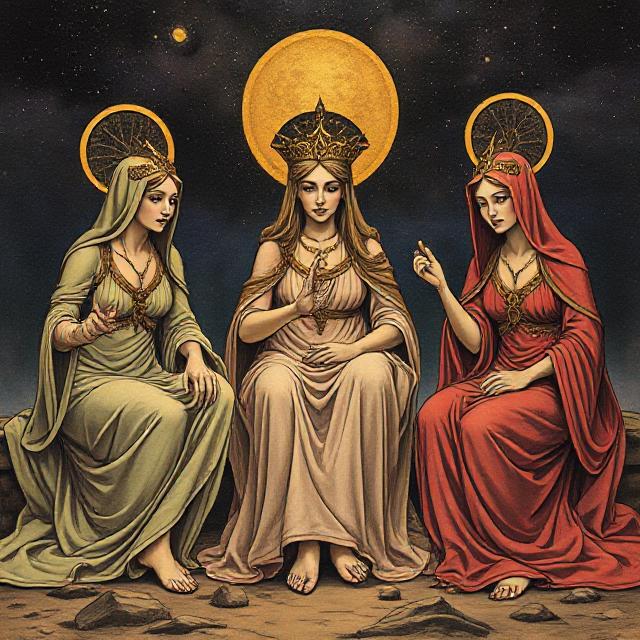
“The Fates have given men hearts that can endure sorrow, yet man must bear the burden of what the gods have decreed.”
Destiny, The Universe, God, The Fates. All convey the same meaning and hold the same power over the lives of humans. One weaving of a threat and someone`s life can spin in a no-ending circle of sorrow or, if lucky, greatness. Through the lens of The Fates, greek mythology comes with the belief that all human lives are pre-destined and that we can do little to nothing to change our course. I have first encountered these mythological characters, in the Disney animated movie, Hercule, where The Fates take the form of three older women who each share one eye that holds all the memories of the past, the clarity of the present and the uncertainty of the future. With their peculiar aspect and the essential role they play, not only for the lives of humans but for the mighty Gods, The Fates, or also known as, The Moirai, quickly sparked my interest.
In history, they are known to be the daughters of the goddess of the night, Nyx or of the powerful Zeus and Themis, the goddess of justice. They do not necessarily embody three people, however they were born more as ideas or a concepts. Each Fate represents a stage of life: birth, living and death. They are either pictured as young goddesses or old wise woman who weave a thread on a loom, a symbol which is always captured besides them.
An aspect about the Fates which took me aback was that even though they hold the threads of existence for all mortals, in most stories they are merely introduced in the plot. This is why I started reading up on their beginnings and the critical purpose they had over the lives of well known characters in greek mythology such as Clotho, the first sister, or ”The spinner”, is entitled with the life of a human while being in the womb of their mother. That is when, typically, the path of destiny is designed for that person. She illustrates the archetype of the creator. The second one is Lachesis, or translated into English, `The Allotter`. The true meaning behind this name stands form the choice of the word. An allotter is someone who distributes or shares something. As in association, Lachesisi offers a limited portion or length of life for each soul, this is why she takes the archetypical role of the Judge. However, at the end of the thread undoubtedly awaits with a scissor, Atropos, the merciless sister. She is also, by no doubt, the most stubborn of the three, and her role as commander of death make her `the un-turnable`. Moreover, the last sister decides on when and how the circumstances of a death will occur for each person and whether or not the mortal will die with dignity. Atropos is the representation of the death archetype.
I am not sure that I personally would want to have any of the mind-blowing abilities The Fates have. Knowing the future might compel me to make different actions or take different paths. However, I do believe I already have one of their aptitudes. All of us, in fact, do. And that is to mold a life. Not someone else`s life, but our own.
I believe that The Fates are a great representations of one`s destiny. The thin thread of life shows only how fragile and fleeting our lives can be, always measured by some kind of divine force which stands beyond our understanding. Their quietness and frugal appearance throughout the timeless stories of ancient Greece depicts them in an aura of mistery and holy force. However, their background presence is inevitable and crucial to every single story, as we cannot ever escape the concepts of birth, life and death even when heavenly powers collide. Whether you believe or not in faith or destiny, there is no denying that sometimes things just seem to go according to a bigger plan, that we might understand only later in life. I choose to write about these figures because, besides the values that many mythological characters represent, The Fates remain mainly abstract concepts, witouth a clear conscience , but which remain the same for each of us.
„And fate? No one alive has ever escaped it, neither brave man nor coward, I tell you—it’s born with us the day that we are born.”
I based my research from: https://www.thecollector.com/fates-greek-mythology/